

- The refinery can now process heavier grades, broadening the pool of potential suppliers and further strengthening supply security
- DCU eliminates the need to import vacuum gas oil (VGO), while the same amount of crude oil is expected to yield up to 30% more diesel
- The project is valued at nearly EUR 700 million, part of a long-term investment cycle by INA and MOL Group in the modernization of the Rijeka Refinery
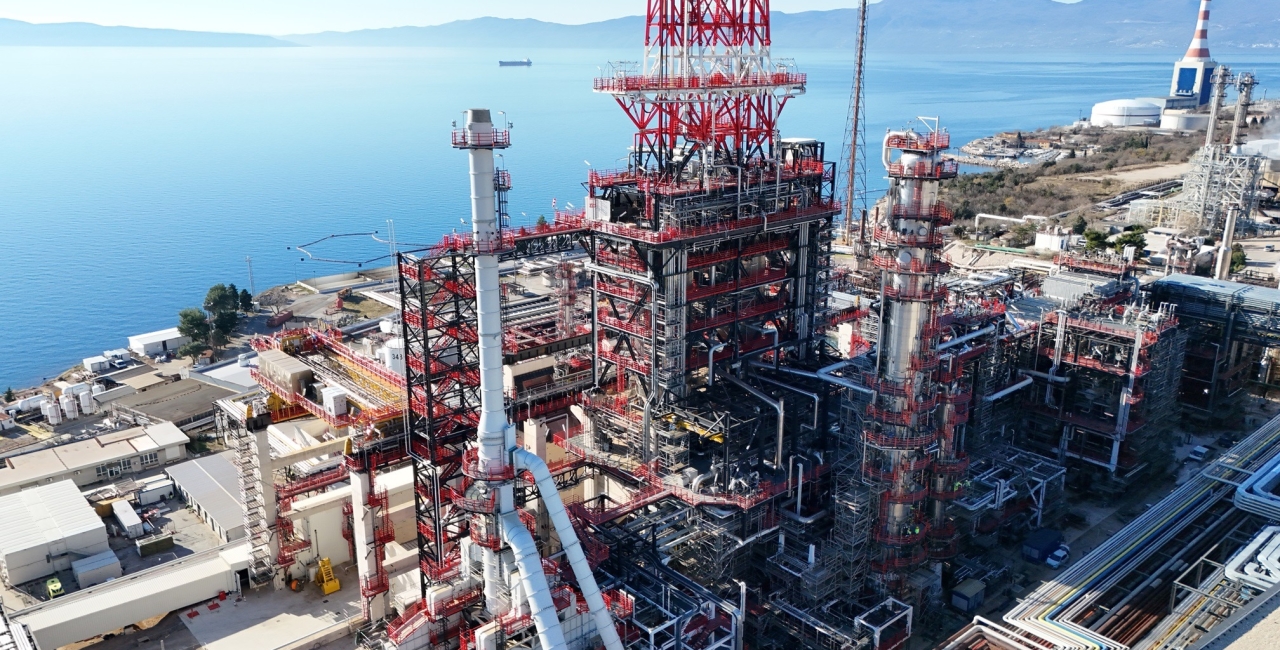
The Rijeka Refinery Upgrade Project has reached another major milestone. Following the successful achievement of Mechanical Completion and commissioning, the new Delayed Coker Unit (DCU) has successfully achieved start-up.
Following the transfer of operational responsibility to INA, feedstock was introduced into the unit on 1 September 2026, marking the beginning of production. Since then, the unit has been operating continuously, reaching approximately 70% of its design capacity. All key products have already been successfully produced at required quality, confirming the successful start-up.
With the start-up of the Delayed Coker Unit, the refinery is now capable of processing heavy residues into higher-value products. The same amount of crude oil is expected to yield up to 30% more diesel. The refinery can now process heavier grades, which makes crude sourcing far more flexible, broadening the pool of potential suppliers. The unit also entirely eliminates the need to import vacuum gas oil (VGO). With this major investment, INA and MOL Group have delivered a project that makes crude processing significantly more flexible, further reinforcing supply security for INA and the wider region.
Zsuzsanna Ortutay, President of the Management Board of INA, noted: “The start-up of the new unit went really well. DCU will improve the sustainability and profitability of our entire refining business. The project is also important for Croatia and the region as it improves energy security and enables a more stable supply for our customers. The success of the project will drive refinery profitability, local community development, and improve the company’s investment potential for further investments in the green transition. Our investments continue in this direction with other projects such as the first green hydrogen production plant currently under construction and the steam back pressure turbine installation which have been completed. Thank you to all colleagues from INA and MOL Group, without whose support this investment would not have been possible.”
The Rijeka Refinery Upgrade Project, which includes the new DCU unit, represents an investment of nearly EUR 700 million. Over the past 12 years, INA and MOL Group have invested a total of 1.3 billion euros in the modernization of refining and logistics infrastructure.
Gabriel Szabó, Executive Vice President of Downstream at MOL Group, highlighted: "Today marks another important step in INA's refining transformation. Following the completion of construction, the successful start-up of the Delayed Coker Unit shows that INA’s biggest single investment in history and one of MOL’s largest-ever industrial investment is now delivering real results. But our work does not stop here. Energy markets remain volatile, so we must continue to strive for stable, high-yield operations to make Rijeka one of the most efficient refineries in Europe. The more flexible our production becomes, the faster we can adapt to unpredictable global challenges. Our goal is to make INA even stronger. A strong INA means a stronger Croatia, a more reliable energy supply throughout the region, and a stronger MOL Group.”
The current focus remains on achieving safe, reliable, and stable operation of DCU, while gradually increasing throughput and optimizing process performance. Stable operation is expected by the end of the year, followed by the final performance testing of the plant, marking the final project closure activities. Once fully operational, the upgraded Rijeka Refinery will be among the most modern refining facilities in the region.
About INA Group
INA Group plays a leading role in the Croatian oil business and holds a significant position in the region in oil and gas exploration and production, oil refining, and distribution of oil and petroleum products. The company consists of several subsidiaries wholly or partially owned by INA, d.d. The Group is headquartered in Zagreb, Croatia. In the field of oil and gas exploration and production, INA currently operates in Croatia and Egypt. Oil refining takes place at the Rijeka Refinery, while the Sisak industrial site is being transformed into a hub for sustainable alternative activities. The regional retail network includes more than 500 service stations in Croatia and neighbouring countries. INA Group is a member of the MOL Group.
About MOL Group
MOL Group is an international, integrated oil, gas, petrochemicals and consumer retail company, headquartered in Budapest, Hungary. It is active in over 30 countries with a dynamic international workforce of 25,000 people and a track record of more than 100 years. MOL Group operates three refineries and two petrochemical plants under integrated supply chain-management in Hungary, Slovakia and Croatia, and owns a network of almost 2400 service stations across 10 countries in Central & South-Eastern Europe. MOL’s exploration and production activities are supported by more than 85 years’ experience in the field of hydrocarbons and 30 years in the injection of CO2. At the moment, there are production activities in 8 countries and exploration assets in 10 countries. MOL is committed to transform its traditional fossil-fuel-based operations into a low-carbon, sustainable business model and aspires to become net carbon neutral by 2050 while shaping the low-carbon circular economy in Central and Eastern Europe.