
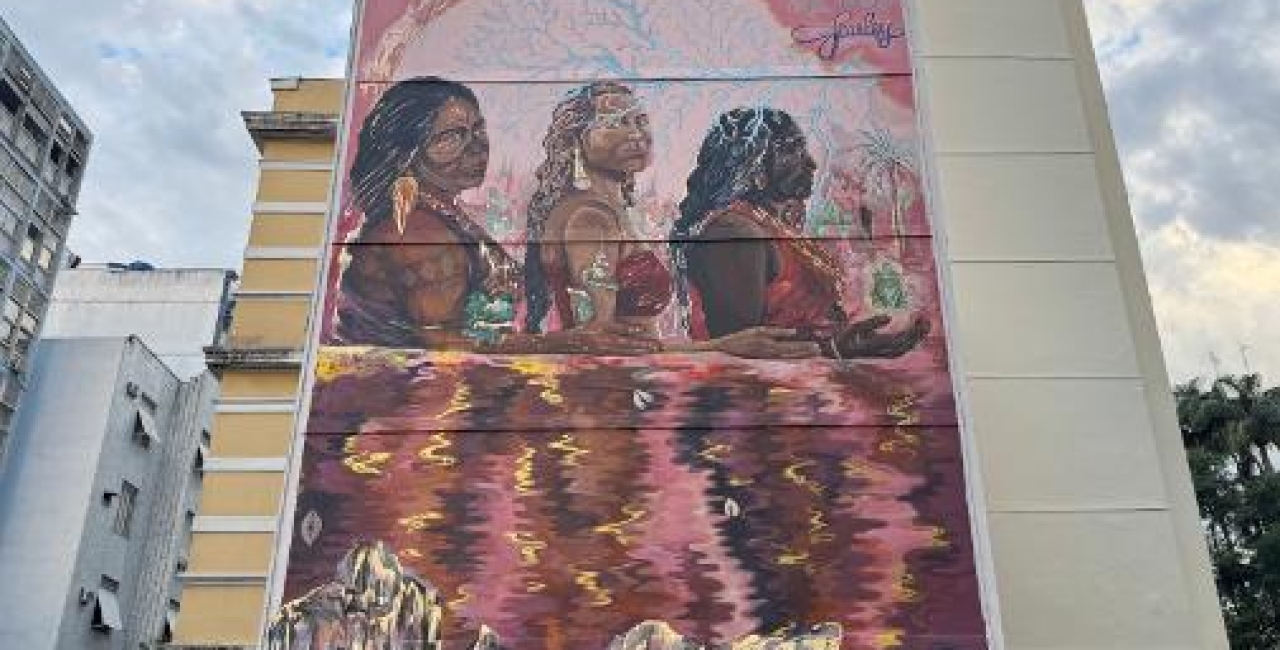
The 30-foot Rio de Janeiro mural symbolizes the struggle of Indigenous, Quilombola, and riverine women to defend Amazonian rivers from industrial threats
Yesterday, artists and organizers unveiled Confluence, a monumental new mural honoring women on the front lines of the fight to defend Amazonian rivers and territories. Standing 30 feet (11 meters) tall, the artwork portrays Indigenous, Quilombola, and riverine women intertwined with the waters that sustain their communities and territories. The project builds on a recent mural celebrating traditional peoples along the Tocantins River, further amplifying a growing movement to defend the Amazon’s vital rivers.
Confluence was created by Indian artist Shilo Shiv Suleman and the Fearless Foundation for the Arts in collaboration with the Enough Soy Alliance, a network of grassroots organizations and movements working to defend territories across the Amazon and Cerrado. The mural grew out of exchanges with communities connected to the Tocantins, Tapajós, and Madeira river basins, bringing the stories, knowledge, and struggles of people whose lives are deeply connected to these rivers into the heart of a major urban center. It features paints made with mud from the Tocantins River, ash from Amazon forest fires, and minerals from India.
“As we moved through the heart of Tauiry in Pará state, beside the river, with the community whose rocks and waters formed the beating heart of their ecosystem, what emerged was this: there is no separation between women’s bodies and the waters we defend. Drawing from that imagery of solidarity among women across the world – the shared struggle against the exploitation of both the body and the land – we painted this image as a testament to women-led movements in defense of sacred waters,” said Shilo Shiv Suleman, founder of the Fearless Foundation for the Arts.
The idea of confluence is woven throughout the mural, reflected both in the intertwined figures of the women and in the Amazonian rivers depicted in the artwork. Confluence honors generations of women whose care, memory, nourishment, and knowledge are deeply intertwined with water and territory. It also shines a light on women-led movements confronting the expansion of large-scale infrastructure and extractive activities that threaten the rivers and communities they sustain.
At the base of the mural lies the Lourenção Rocks (Pedral do Lourenção), a rocky formation in the Tocantins River that sustains fishing grounds, livelihoods, and cultural traditions for riverine and fishing communities. A federal blasting project threatens the site. The project aims to open a navigation channel for the Araguaia-Tocantins Waterway and expand cargo transportation. Days before organizers unveiled the mural in Rio de Janeiro, surrounding communities formally petitioned Brazil’s National Institute of Historic and Artistic Heritage (Iphan) to grant the unique formation federal protection as national historical, archaeological, landscape, and ethnographic heritage.
At the base of Confluence is the Lourenção Rocks (Pedral do Lourenção), a unique rocky formation in the Tocantins River that supports fisheries, livelihoods, and cultural traditions for riverine and fishing communities. The site is threatened by an approved government project to blast through the formation and open a navigation channel for the Araguaia-Tocantins Waterway, facilitating expanded cargo transportation for the agribusiness sector. Just days before the mural was unveiled in Rio de Janeiro, communities from the surrounding region formally petitioned Brazil’s National Institute of Historic and Artistic Heritage (IPHAN) to recognize and protect the formation as a site of national historical, archaeological, landscape, and ethnographic heritage.
For Claudelice Santos, general coordinator of the Zé Claudio and Maria Institute, a member of the Enough Soy Alliance, bringing these Amazonian stories to Rio de Janeiro is a way to break through the invisibility surrounding territorial conflicts and build broader support for the defense of the region’s rivers.
“We want to make visible not only the threats facing Amazon river basins, but the alliances already working to protect them,” said Santos. “Defending a territory means defending its waters, forests, people, and all the forms of life connected to them. These are not empty spaces – they are living, interconnected ecosystems that we all depend on.”
Confluence also echos the “Our Territories, Our Lives,” campaign led by the Association of Brazil’s Indigenous Peoples (APIB), which calls for a national vision that recognizes territories as fundamental to protecting life. As Brazil’s elections approach, the campaign also underscores the importance of ensuring that Indigenous peoples and other traditional communities have a stronger voice in forums where decisions about climate, territories, and development are made.
“When I look at these three women – Indigenous, riverine, and Quilombola – I also see a message about where many of the answers to the climate crisis lie: in the territories and in knowledge that generations have passed down,” said Lilian Terena of APIB. “Our territory is not simply a piece of land. It is a sacred space; it is our life. And if we want to discuss the future of the planet, Indigenous peoples, Quilombola communities, and traditional communities must also participate in political decision-making spaces.”
Before arriving in Rio de Janeiro, the Fearless team traveled to Vila Tauiry, in Pará, where artists and residents collectively created the created the first mural dedicated to Pedral do Lourenção and local communities’ relationship with the Tocantins River. Both murals form the Confluence project, which connects movements across the Amazon and South Asia through participatory public art.